
Dave Strijbos and Cagiva become 125 cc World Champions
06/08/2026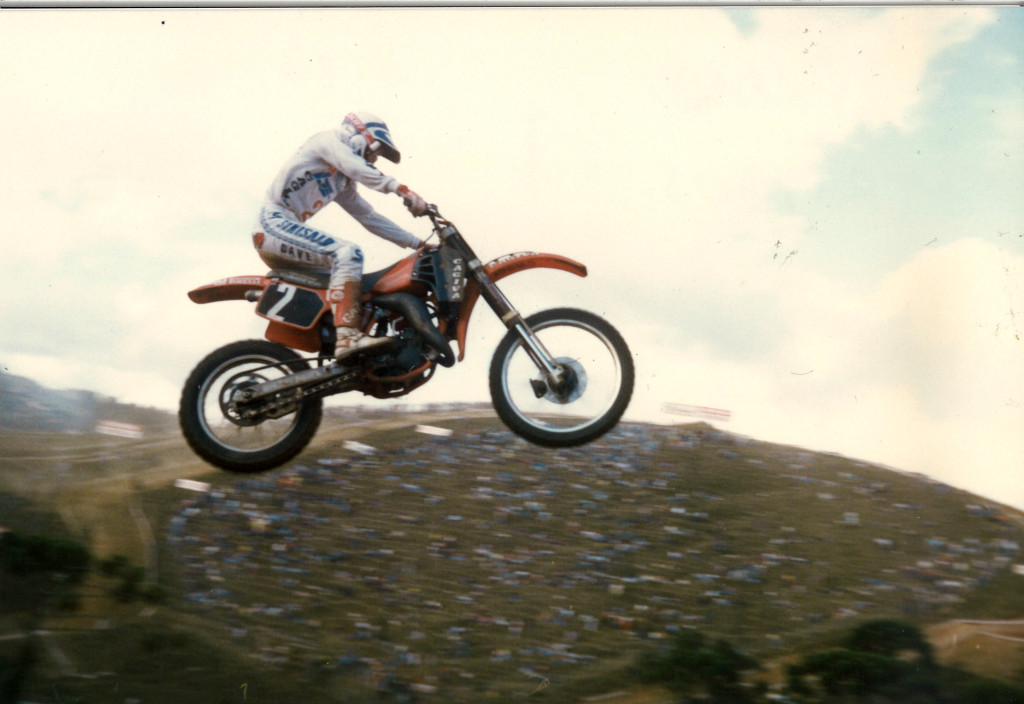
After losing the 125 cc World Championship in 1985 to Pekka Vehkonen and Cagiva, the young Dutch rider Dave Strijbos left the Honda CR of Jan de Groot’s Venko team the following year and was signed by the Italian manufacturer itself. It was Jan Witteveen, Cagiva’s Technical Director, who wanted him on the team, with Vehkonen and Massimo Contini. Massimo was racing for the Team Giunta and carrying out the development work previously done by Corrado Maddii.
Without a doubt, in 1986 Cagiva was the strongest team among those entered in the 125 cc World Championship, and the Italian bike was the most competitive. There were few changes compared with 1985 version. Torque was increased and the engine’s operating range improved by reducing the horsepower from 37 to 34/35, whilst in terms of suspension, it is worth noting that each rider used different forks: WP for Strijbos, Öhlins for Vehkonen (both upside-down) and a traditional Marzocchi for Contini.
The first round of the 1986 World Championship took place on 6 April at Casteinau de Levis, in France, where the reigning World Champion Pekka Vehkonen triumphed in a sea of mud. A week later, on the sandy track at Mill in the Netherlands, it was Strijbos who scored a one-two, whilst Vehkonen ended up in the infirmary after a nasty crash in practice. Finally, to seal the dominance of the Schiranna-based manufacturer, on 20 April at Grottazzolina, it was Contini’s turn to win the Italian Grand Prix, taking both races.
To witness a victory by a rider not riding a Cagiva, one had to wait until the Belgian Grand Prix in May, when Van den Berk’s (Yamaha) one-two finish – having won the first race – was dashed by a puncture whilst he was firmly in the lead in the second race as well.
In June at Lerida Mongay, in Spain, Strijbos lined up as championship leader, but with a right shoulder injury sustained in a Dutch championship race, he had to concede defeat to Vehkonen and Van den Berk, who each won a heat.
Having more or less recovered in time for the next Grand Prix, at Dalecin in Czechoslovakia, Dave won one race and was beaten by Contini in the other following a fine team performance that saw the Cagiva riders occupy the top three positions in the championship standings at the end of the Grand Prix.
At Killichy in Ireland, Contini suffered a sprained knee, whilst the GP was dominated by Finnish riders thanks to victories by Vehkonen and Kouki, the latter riding a Yamaha. The championship standings remained very tight, however, with several riders separated by just a few points; a single mishap or crash was enough to lose one or more positions.
Vehkonen knows this all too well: during practice for the Swedish Grand Prix at Vrigstad, he injured his collarbone and was forced to miss the race, only to be overtaken in the standings by Van den Berk.
At the next two rounds in Esbach (West Germany) and Pujo (Finland), Contini and Van den Berk both scored double wins, but it was only the latter who had enough points to challenge the championship leader, Strijbos, for the title during the two-round South American tour which, as in 1985, brought the championship to a close.
In Salta, Argentina, Strijbos took a firm hold on the title by winning both races, whilst the Yamaha rider struggled as his bike performed bad due to the poor quality of the local petrol. In Brazil, however, on the unfamiliar track at Campos de Jordão – which replaced the Belo Horizonte circuit at the last minute and which nobody was familiar with – the American Micky Dymond won both races on a Honda, whilst Strijbos finished second twice, ahead of another American, Rodney Smith, who was riding a standard Cagiva WMX.
With Van den Berk failing to make the podium, Dave Strijbos was thus crowned World Champion at the age of 18 years and ten months, becoming the youngest world champion in motocross history. A record that stood for 25 years before being broken in 2011 by Ken Roczen, who won the MX2 title at the age of 17. Massimo Contini, meanwhile, clinched the Italian title.
The one won by Strijbos in 1986 will remain the second and last world title won by Cagiva in Motocross.
The 1986 Cagiva
The bike that won the World Championship with Strijbos is an evolution of the one that had triumphed with Vehkonen the previous year.
The engine loses a couple of CV to improve torque and a wider operating range. The two crankcases and the covers are made of magnesium, whilst the cylinder is made of a light alloy, sand-cast. It has a smaller crankshaft than the standard WMX – reduced from 96.4 mm to 90 mm – and a smaller crankcase. To compensate for the loss of inertia caused by the smaller crankshaft, the flywheels are balanced with inserts made of Mallory, an alloy of tungsten, copper and chrome. Whilst maintaining the same bore-to-stroke dimensions of 56 x 50.6 mm, longer connecting rods and shorter pistons are fitted. The airbox and carburettor are also new, the latter now equipped with a Power-Jet system. Compared to the 1985 model, the connecting rods have a longer centre-to-centre distance, reduced from 110 to 105 mm; consequently, the Mahle piston reduces the distance between the piston pin and the top of the piston from 30 to 25 mm. The reed valve intake is regulated by an Adler assembly, whilst the exhaust is fitted with a mechanically operated throttle valve featuring the CTS system. The Dellorto flat-valve carburettor has a 37 mm throat; the gearbox remains a six-speed unit, as does the Motoplat electronic ignition.
Suspension aside, as mentioned, the three Cagiva riders used forks and monoshocks from different suppliers; as for the chassis, the split cradle frame made from chromium-molybdenum steel tubes retained the dimensions and geometry of the 1985 version. Unlike the production WMX frames intended for privateers, those of the factory bikes were TIG-welded and manufactured in-house at Cagiva’s racing department. The swingarm featured a modified mono-shock linkage, made very similar to that of Honda’s Pro-Link system, with a link designed to provide greater progressive damping.
Strijbos used WP suspension, and his upside-down fork had a 40 mm diameter, billeted triple clamps, with a 185 mm centre distance and 18 mm offset. His handlebars were aluminium Renthal, with a bolted crossbar and a bent section modified to suit the Dutch rider’s requirements. The wheels feature Takasago Excel rims and cast magnesium hubs. The front Brembo disc brake measures 230 mm, whilst the rear single-cam drum brake has a floating shoe and a bolted cast-iron ring.
The development work carried out by the Racing Department between 1985 and 1986 focused on weight reduction and the bike’s ergonomics. Thanks to the extensive use of Ergal, magnesium and titanium bolts for the frame and components, the weight of the Cagiva 125 was close to the regulatory limit of 88 kg.
The 1986 model is slightly smaller than the 1985 version. The fuel tank is lower and has a smaller capacity, the seat is more tapered, the sides are 3 cm narrower, whilst the number plates are larger because the FIM required an increase in their size to allow for easier reading of the race numbers. The air ducts on either side of the fuel tank are also larger, as the surface area of the two radiators has increased, with the left-hand one being longer.