
The Last Dance
01/09/2026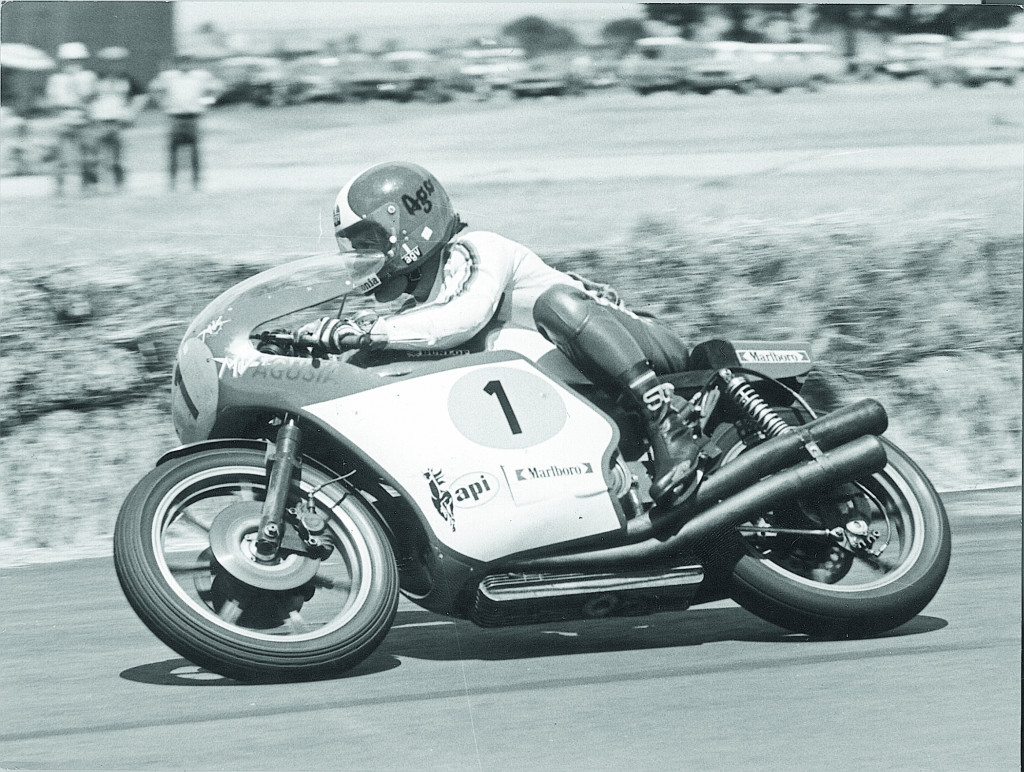
On Sunday 29 August 1976, the West German Grand Prix, eleventh round of that year’s World Championship, took place at the Nürburgring circuit. Barry Sheene was absent from the 500 cc; having mathematically secured the World Championship title at Anderstorp on 25 July with three Grands Prix still to go, he had decided to stay at home and begin the celebrations.
The weather has been unpredictable ever since practice began. Heavy rain alternate with sudden clear spells, making the 22.835 km of the fearsome Nordschleife even more dangerous. Pole position went to Virginio Ferrari on the Gallina team’s Suzuki RG 500 MKI, who clocked a lap time of 8’53”9 at an average speed of over 153 km/h and was ready to line up alongside the other fifty-three riders qualified for the Grand Prix. Among them was Giacomo Agostini, who was coming to the end of a season that had fallen short of expectations.
The Italian rider, having won his fifteenth and final World title, had ended his contract with Yamaha at the end of 1975 and founded his own team, in which he held the dual role of rider and team manager. After MV Agusta’s withdrawal from competition, Agostini had taken over the management of the old racing department at the Cascina Costa based manufacturer and, supported in the pits by the men who had accompanied him for much of his career, had returned to the saddle of the Italian four cylinder machine, the only four stroke bike entered in the World Championship.
The MV was still competitive in the 350 class, but unfortunately things had different in the 500 class. After just two Grands Prix with Agostini finished off the podium, the MV Agusta had been replaced with a standard Suzuki RG 500 MKI fitted with official XR parts, on which he had made his debut at the Dutch Grand Prix after completing practice sessions on the MV.
However, the remedy proved worse than the disease. On the Suzuki, Agostini had secured two pole positions, at Mugello and Imatra, but in the five Grand Prix races he contested on the Japanese bike, he was always forced to retire due to mechanical problems.
In Germany, too, he used the RG in practice, but on race day he decided to leave it in the pits, opting instead for the glorious MV Agusta because rain was forecast and, on a wet track, the Italian bike offered more manageable power delivery than the Japanese four-cylinder.
The first races of the day at the Nürburgring – the 50 cc class, won by Angel Nieto, and the 350 cc class, won by Walter Villa – started and finished under black clouds but on a dry track, whilst rain began to fall during the 125 cc race, causing various crashes amongst the riders chasing Anton Mang, who led from the first to the last lap.
The rain stopped during the 250 cc race, which saw another victory for Walter Villa, but by the time the 500 cc class got underway, the track was still wet in numerous places, particularly in the Adenau forest and on the stretch from the Karrussel to Eschbach.
At the start, Agostini set off cautiously, but it took him only a few km to take the lead and break away, with the rest of the field chasing him in vain. At the end of the scheduled seven laps – covering almost 160 km of solo racing – his lead over the runner-up, Marco Lucchinelli on the Gallina team’s second Suzuki, was 52 seconds, whilst the third rider to cross the line, the American Pat Hennen, finished one minute and ten seconds behind.
Agostini’s triumph that day in Germany was of historic significance for several reasons. For the Italian rider, the race on 29 August at the Nürburgring was his 122 nd and penultimate world championship victory of his career (though his last in the 500 cc World Championship), whilst for MV Agusta it was the final victory in the World GP Championship, thus bringing to a close the history of the glorious Italian manufacturer, which withdrew from competition at the end of that season.
It was not until 7 April 2002, with Valentino Rossi’s victory on the Honda RC211V at Suzuka in the Japanese Grand Prix, that a four stroke motorcycle was once again seen on the top step of the podium at a Grand Prix in the premier class of the World Motorcycle Championship – which had by then become MotoGP.