
Total Dominance
18/06/2026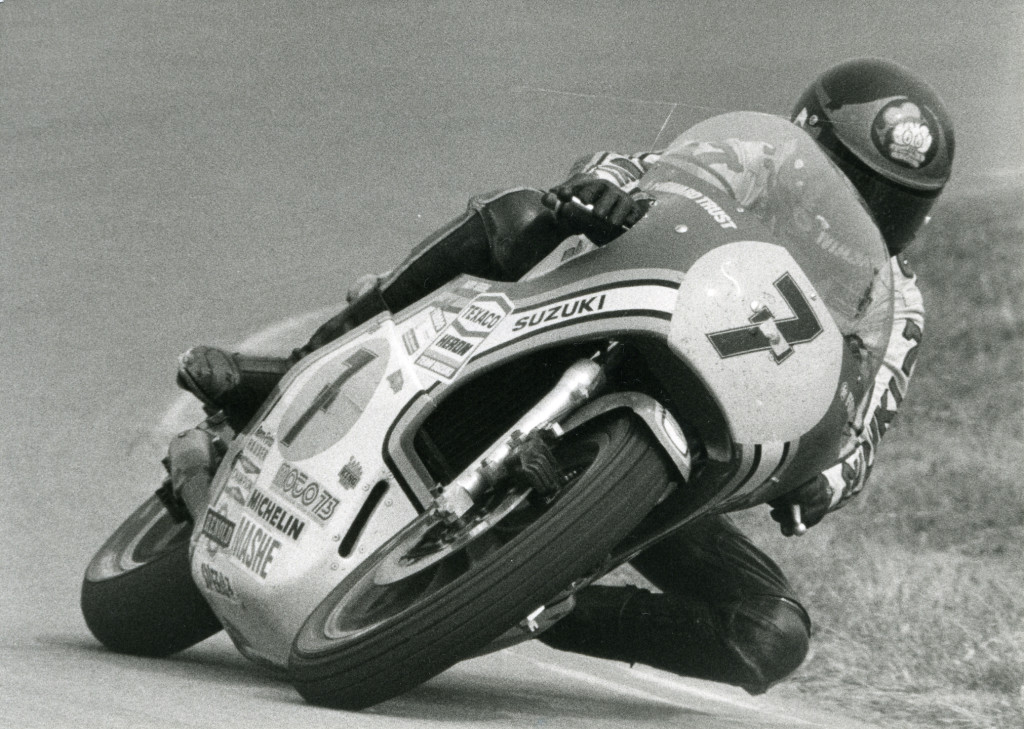
The 1976 season was a very important one in the history of the 500 cc class, as it marked the handover from the old ‘Continental Circus’ – immortalised by the film of the same name by French director Jérome Laperrousax – to a new kind of World Championship. One that was more fascinating and spectacular and, if you like, much better suited to sponsors and television. It is no coincidence that it was from 1976 onwards that Grand Prix races began to be broadcast on television with some regularity and that motorcycling ceased to be regarded as a niche sport.
The testimonial of this new era was Barry Sheene. The English rider was photogenic, rode the Suzuki XR 14 – the most desired bike on the grid – and was engaged to Stephanie McLean, the most beautiful girl in the paddock.
Barry is a character who really commands the screen. He is a chain-smoker, rubs shoulders with musicians and actors from London’s jet set, has an exuberant and carefree personality, and on the track he is instantly recognisable by his unmistakable full-face helmet decorated with the face of Donald Duck, the famous Disney comic character. At Suzuki, he has been regarded as something of a hero ever since 28 June 1975, when – whilst still recovering from a crash during practice for the Daytona 200 and with his leg full of metal pins – he secured the first 500 cc World Championship victory for the Suzuki four-cylinder engine, overtaking Giacomo Agostini at Assen in the corner before the finish line during the final lap. Indeed, when the Hamamatsu-based manufacturer decided to withdraw its team from the 500cc World Championship, his was the only name put forward to Team Heron, the British outfit responsible for managing the factory Suzuki team.
In 1976, the Tourist Trophy featured on the world championship calendar for the last time, even though the big names in the World Championship, led by Sheene, had for years refused to race it. 1976 was also the last season to see MV Agusta on the starting grid, albeit with a private team set up by Giacomo Agostini, who had been left without a ride following Yamaha’s withdrawal at the end of 1975.
The 500 cc calendar featured 10 Grands Prix, with the season kicking off on 25 April at Le Mans and close on the gruelling Nordschleife at the Nürburgring on 29 August.
Barry secured pole position in France but injured his leg in a crash during practice. This affected him at the start – given that, at the time, riders had to push-start their bikes – but it did not prevent him from winning the Grand Prix ahead of Cecotto and Lucchinelli.
Sheene also finished first at Salzburg after a furious comeback to make up for a terrible start, culminating in a spectacular overtaking manoeuvre on Phil Read, who was leading at the time, during the ninth lap. After the Austrian Grand Prix, his triumphant run began: Barry won the Italian Grand Prix at Mugello, beating Read in a sprint to the finish line, and was once again on the top step of the podium at Assen, during the Dutch Grand Prix, when he finished 45 seconds ahead of the runner-up, the American Pat Hennen.
His run of success then continued with a second-place finish in Belgium at Spa-Francorchamps, where he was pipped at the post on the final lap by his team-mate John Williams, and with his final victory of the season in Sweden, at Anderstorp, on 25 July.
At this stage, with three GPs remaining in the World Championship, Barry is mathematically the World Champion, ahead of Lansivuori and rookie Pat Hennen. With his victory in Finland, a week after the race at Anderstorp, Hennen becomes the first American rider to win a World Championship GP.
Whilst the US national anthem echoed through the woods of Imatra, Sheene was at home. Having secured the title, he chose to skip the final three Grands Prix on the calendar – Finland, Czechoslovakia and Germany – and start the celebrations early. Following his 1976 title, Sheene repeated the following year, and when he retired from Grand Prix racing at the end of 1984, his record stood at 23 Grand Prix wins in total (19 victories in 500 cc). These figures alone do not do justice to his greatness.
Fifty years have passed since that 25 July 1976. No British rider has ever since won a title in the top class of the World Championship, and Barry is no longer with us, having been taken from us by an incurable illness in 2003. But his legend remains undimmed. With him, motorcycling ceased to be merely a sport and became a language of the people.
For this reason, Goodwood – the circuit in Sussex where Sheene won his final race just a few months before his death – has decided to dedicate all three of its 2026 motorcycling events to him: the 83rd Members’ Meeting on 18–19 April, the Festival of Speed on 9–12 July and the Revival on 18–20 September. The most important event will, of course, be the Festival of Speed, where Freddie Sheene, Barry’s son, will ride some of the most iconic motorbikes from his father’s career, wearing a leathers and helmet featuring the graphics made famous by the British rider.