
1976: Springsteen’s first title
21/10/2026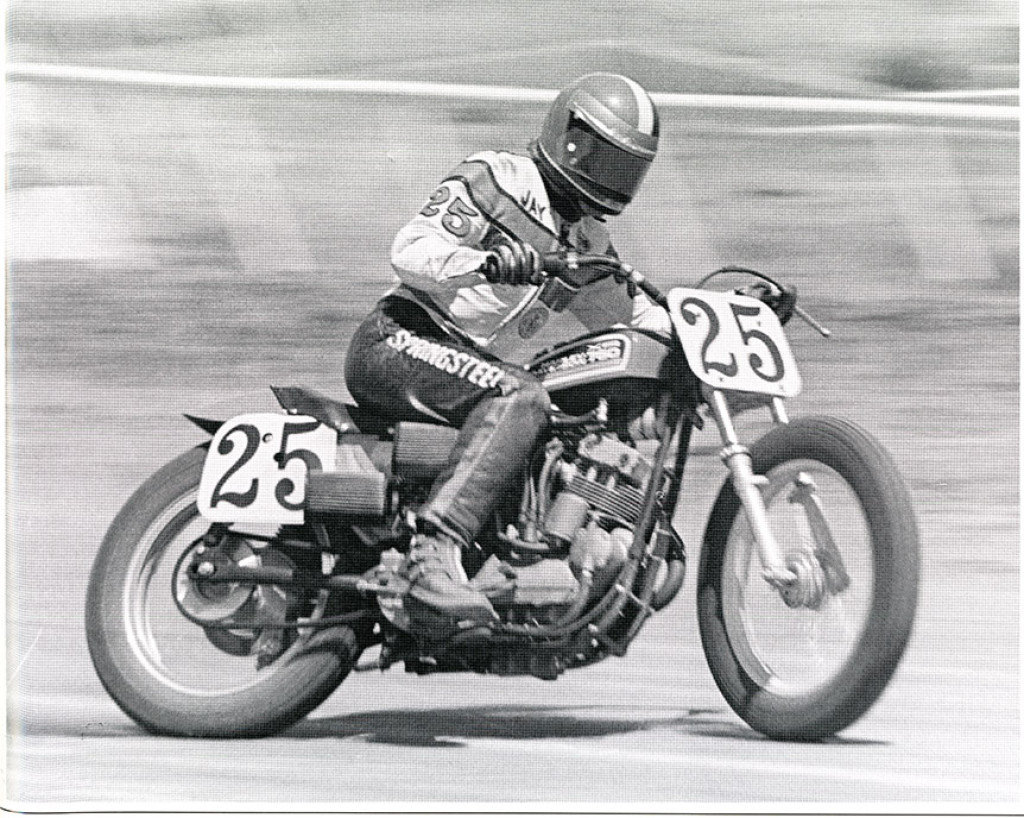
Flint is an industrial town in Michigan, about a hundred kilometres from Detroit, and it was the cradle of the American car industry. Buick, Chevrolet and General Motors were founded here in the early 20th century and continued to operate factories for a long time even after moving their headquarters elsewhere.
After the Second World War, however, things changed: the car manufacturers closed their factories, plunging the town’s economy into crisis, whilst high levels of out-migration, unemployment and poverty turned Flint into a deprived area.
Being born and growing up here has never been easy, unless you have an iron will. It is no coincidence that the two greatest riders in the history of Flat-track racing – an extremely gruelling discipline that demands suffering and sacrifice – hail from Flint.
Jay Springsteen and Scott Parker won a combined total of nine Grand National titles – a sort of “overall“ championship, now stopped, established in 1954 by the American Motorcycle Association (AMA), in which points could be earned across all events in the various motorcycling disciplines: Flat-track, Road-racing, Cross and Enduro – which they dominated for more than twenty-five years.
Parker, with his six titles and 94 victories, is the more successful of the two, but if you ask who was the most beloved, there is only one answer: Jay Springsteen.
Jay was born in Flint on 15 April 1957 into a working-class family. His parents worked at a General Motors bus factory, but at week-ends his father competed as an amateur in Flat-track racing.
At the age of nine, he rode his first motorbike and, at sixteen, made his debut in the Michigan championship, demonstrating extraordinary talent. By 1975, he was already competing in the Grand National. He won two races on half-mile ovals, finished on the podium on four other occasions and ended the championship in third place, becoming ‘Rookie of the Year’.
Harley-Davidson didn’t think twice about signing him, entrusting him to the care of Bill Warner, the engineer who had tuned the title-winning XR 750 ridden by Gary Scott in the season just ended.
Springsteen and Warner shared the same winning mentality, and at just nineteen, Jay found himself already in contention for the title, heading into the final race at the top of the standings. A seventh-place finish would have been enough to secure the title, but Jay made life difficult for himself by fracturing a finger in practice whilst trying to find the limits of his new tyres. The following day, with his hand bandaged and swollen like a melon, he claimed his first number one finish ahead of Kenny Roberts and Gary Scott. He was nineteen years old, and the future of flat-track racing belonged to him.
In 1977, he retained his title by beating Roberts once again, even though Kenny in addition to Flat-Track racing, also competed and won in the Road-racing category, earning points towards the Grand National standings.
With his second title, Springsteen earned $30.000, roughly double what he had earned the previous year, but nothing compared to the $80.000 pocketed by Roberts. He did not complain, however, and set his sights on 1978, the season that would cement his legacy.
That year, his dominance was so overwhelming that the other riders suspected he was receiving preferential treatment from H-D or that his bike did not comply with the regulations.
With his 1978 victory, Jay became the first rider to win the Grand National title three times in a row and the only one to have done so whilst competing exclusively in Flat-track racing. At this point, it seemed easy to predict many more seasons of victories.
Instead, in 1979, something snapped inside him. In the early races, he appeared unfocused and unable to keep up the pace. The qualifying heats left him physically drained, whilst the stress of the final sent him into a tailspin after just a few laps.
His rivals pulled away in the championship; Springsteen began going in and out of hospital without the doctors being able to explain his illness, whilst rumours began to circulate in the paddock that his problems were linked to drug abuse.
Harley-Davidson decided to put their faith by renewing his contract for the following season, but Jay was unable to regain his form and by 1980 he had suffered a complete collapse. Zero wins, his popularity in freefall and repeated hospitalisations.
Many urged him to retire, but he decided not to give up. Slowly, he began to turn things round and by 1982 he seemed to be back to his old self. He battled it out for the Grand National title with Ricky Graham and only lost out in the very last race by just two points.
That day, the crowd did not cheer the new champion but the resurgent Springsteen who, thanks to his victory in the one-mile race at Sacramento, also became the first rider in AMA history to win thirty Grand National races.
In 1983, he finished the championship in third place with five wins and eleven podium, and also won the “Battle of the Twins” at Daytona on “Lucifer’s Hammer”, proving he was just as strong on tarmac as he was on dirt ovals.
But another break due to health issues was just around the corner, arriving right on schedule a few months later. In 1984, after just four Grand National races in which he had secured three second-place finishes, he decided to call it a day. It was at that moment that he realised he would never again be the unbeatable rider he had been during the 1976-1978 era, and that he would have to live with his mysterious physical blackouts for the rest of his life.
But despite this, he decides once again not to throw in the towel. For him, winning the Grand National is no longer important; what matters is racing without too much pressure, simply being true to himself. Obviously, with these expectations, it is no longer possible for him to remain an official H-D rider and continue his relationship with Werner. The two went their separate ways, and Bill moved on to look after the bike of Scott Parker.
Springsteen organised things himself, with his wife acting as his manager, one mechanic in his entourage and another at home to prepare the engines. And step by step, he won back the public’s favour. After every race, people comes for an autograph or to shake his hand, and he repaid his fans with a few rare victories and an endless string of podium finishes, season after season. The final breakdown of his health, however, came in 1991, ironically, in the season that saw the rise to fame of his fellow townsman Scott Parker.
His most recent victory, however, came in Springfield in 2000, when, at the age of 43, he became the oldest winner of a race in the history of the Grand National.
“I still want to ride a bike - he said on that occasion - it’s the only thing I know how to do. I smoke, I drink and I’m over forty. But it all still comes naturally to me. Some of my younger rivals say they feel worn down by the pressure. I know exactly what that means...”
Today, Jay Springsteen, on the eve of his seventieth birthday, is a Flat-track icon and a shining example of resilience in the face of the stresses of racing and of love for the sport.