
SPEED LEGENDS AT EICMA 2026
11/11/2026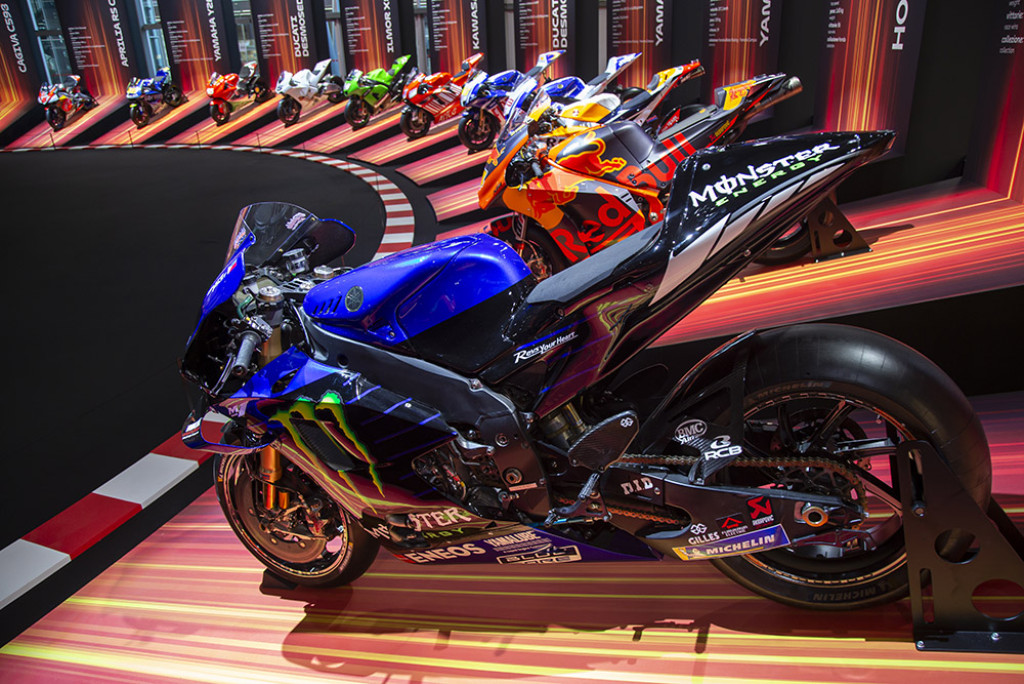
On Sunday, November 8, the 83rd International Two-Wheeler Exhibition ended at the Fiera Milano Rho exhibition complex.
The 2026 edition was the largest ever organized: for the first time, EICMA occupied 10 pavilions, covering a total area of 300.000 square meters. A total of 600.000 visitors were recorded—an increase of 6% over the previous edition—along with a 30% rise in the number of international industry professionals in attendance.
One of the most exciting attractions was “Speed Legends,” an exhibition dedicated to the history of the premier class of motorcycle racing. Born from a partnership between EICMA and MotoGP™, the exhibition was organized under the patronage of the FIM—which provided iconographic material from its digital archive and assisted in sourcing the motorcycles on display—with additional contributions from the Racing Motorcycle Museum.
Over the course of six days, more than 150.000 visitors—with entry numbers strictly controlled to manage capacity and ensure the safety of the displayed machines—journeyed through seventy-seven years of competition. This history was told through the motorcycles ridden by true legends, including Giacomo Agostini, Kevin Schwantz, Michael Doohan, Eddie Lawson, John Kocinski, Valentino Rossi, Jorge Lorenzo, Marc Márquez, Casey Stoner, Phil Read, Franco Uncini, Francesco Bagnaia, and Fabio Quartararo.
The spectacular exhibition, staged in Hall 22, featured 32 motorcycles. At its center stood the AJS E90 “Porcupine”—the bike with which Leslie Graham won the inaugural 500cc World Championship in 1949—alongside Jorge Martín’s Aprilia RS-GP, which represented the state-of-the-art in contemporary Grand Prix racing motorcycles.
Arranged around the outer circular ring were thirty iconic machines. The exhibition began with Ken Kavanagh’s 1955 Moto Guzzi 8-cylinder, followed by John Hartle’s 1958 MV Agusta 6-cylinder and Malcolm Uphill’s 1960 Norton Manx.
The 1960s and 1970s were represented by Derek Minter’s 1963 four-cylinder Gilera, alongside Mike Hailwood’s 1969 Benelli Quattro and 1970 Kawasaki H1-R ridden by Christian Ravel, the 1971 Ducati 500 twin-cylinder ridden by Bruno Spaggiari, and the 1973 Paton 500 ridden by Armando Toracca. These were joined by the MV Agustas of Giacomo Agostini (1971) and Phil Read (1974), as well as Agostini’s 1975 Yamaha OW23—the first two-stroke motorcycle to win a 500cc World Championship.
Barry Sheene’s 1977 Suzuki XR22 and Franco Uncini’s 1982 Suzuki XR40 introduced the public to yet another unforgettable era. Ron Haslam’s Elf 3 and Eddie Lawson’s Yamaha OW86—both from 1986—were followed by Kevin Schwantz’s 1990 Suzuki RGV, Mick Doohan’s 1992 Honda NSR, and John Kocinski’s 1993 Cagiva C593.
The MotoGP era was opened by Colin Edwards’ 2003 Aprilia RS Cube; Valentino Rossi’s 2004 and 2009 Yamaha YZF-M1s; the 2006 Ducati Desmosedici GP6 (ridden by Loris Capirossi) and Ilmor X3 (ridden by Garry McCoy); Olivier Jacque’s 2007 Kawasaki ZX-RR; and Casey Stoner’s 2008 Ducati Desmosedici GP8.
The narrative continued with Jorge Lorenzo’s 2010 Yamaha YZF-M1, Marc Márquez’s 2013 Honda RC213V, Pol Espargaró’s 2018 KTM RC16, and Fabio Quartararo’s 2021 Yamaha YZF-M1... Pecco Bagnaia’s 2022 Ducati Desmosedici GP22.
The inauguration of Speed Legends was attended by Giacomo Agostini and Franco Uncini, alongside EICMA executives and representatives from MotoGP™ and the FIM. Speaking on behalf of the latter, Damiano Zamana—FIM Deputy CEO & Operations Director—reaffirmed the International Motorcycling Federation’s commitment to promoting and preserving the heritage and historical legacy of motorcycle sport, both through its "Heritage" program and via initiatives such as Speed Legends.